Essays
Stitch by Stitch
A look at Sashiko, the Japanese tradition of stitching, repair and reinforcement, and the cultural ideas held within its repeated patterns. The piece considers what this practice can tell us about craft, memory and the value of things made to last.

There’s a quiet discipline to Sashiko. At first glance, it’s a running stitch—measured, minimal, symmetrical. But that regularity isn’t ornamental. It’s historical. It’s regional. It’s deeply encoded and grounded in necessity, humility, and cultural memory.
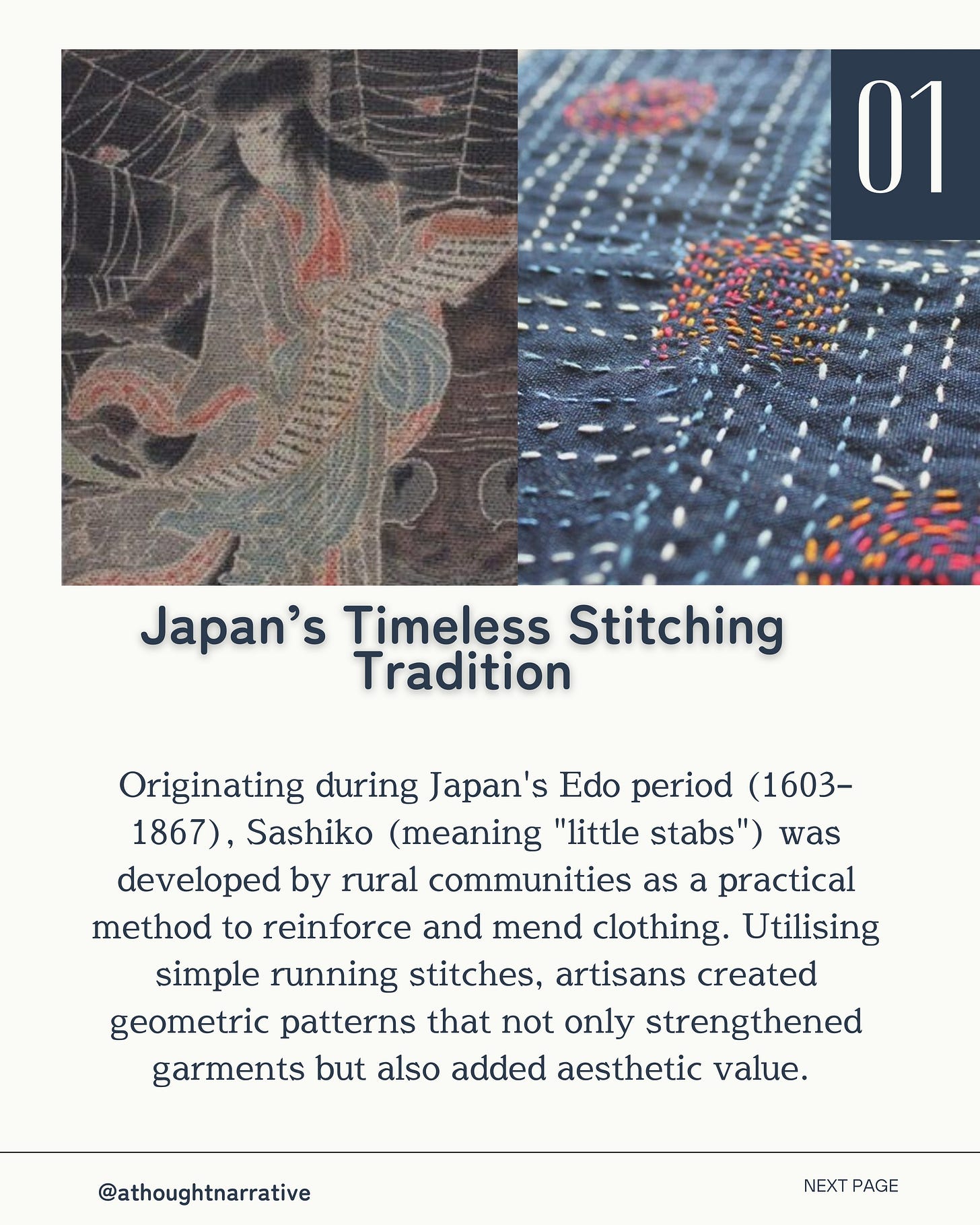
Sashiko originated during Japan’s Edo period (1603–1867), not as art, but as an economic and climatic adaptation. In the country’s northern and rural regions, particularly Tōhoku, winters were long, fabrics scarce, and garments had to endure. Stitching became a form of survival, repeated not for aesthetic value, but for efficiency and strength. It was meticulous work, often done by women at home, late into the night, piecing together cotton scraps or linen remnants into garments that could be worn a little longer, weathering one more season. And over time, this reinforcement method gave way to a quiet system of symbolism. It was called Sashiko, meaning “little stabs.”
The repetition that once served the economy began to signal belief. Over generations, specific patterns took hold as embedded forms of cultural expression.
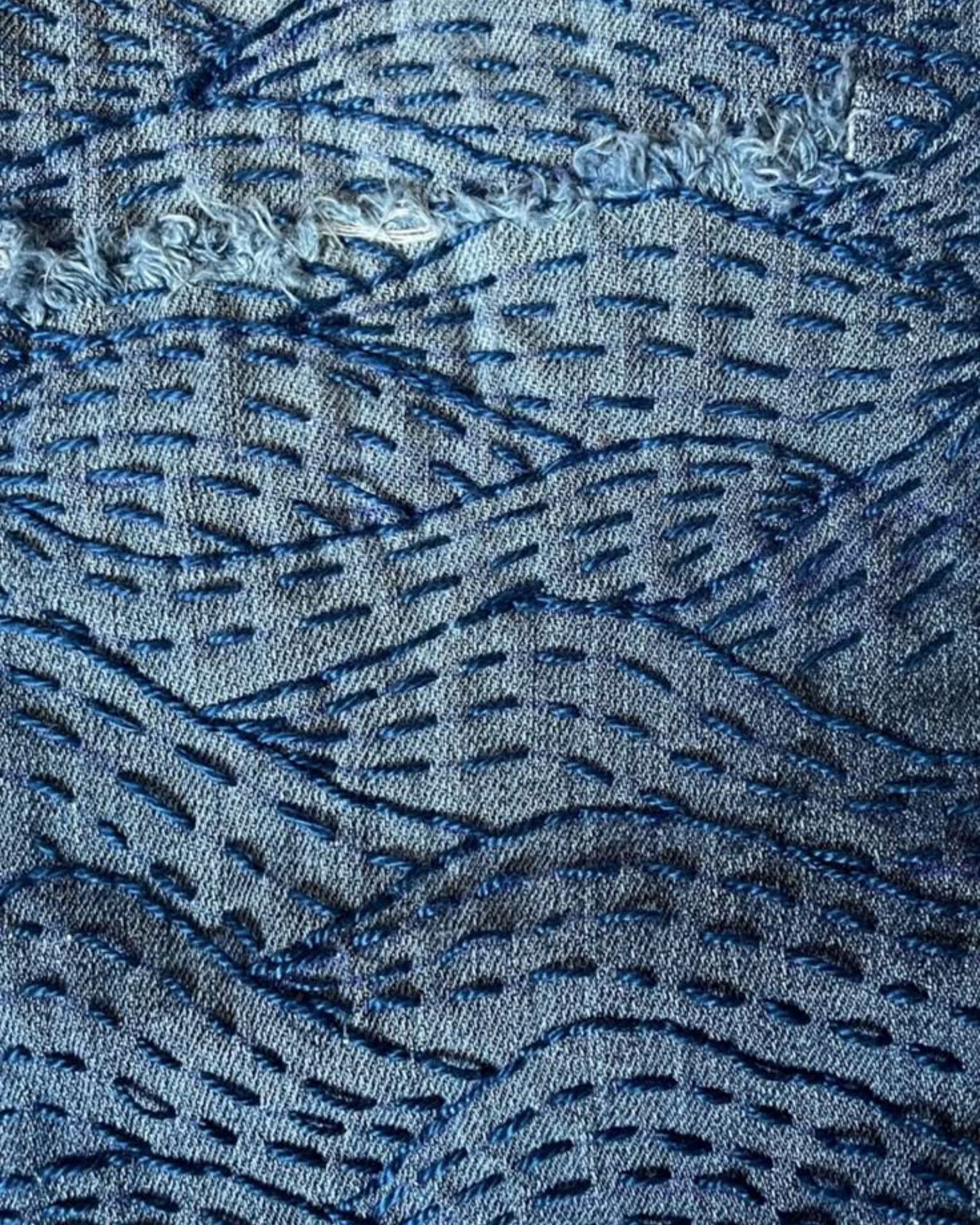
Seigaiha (青海波): Representing waves, this motif evokes the sea’s persistence and the calm it offers. To wear Seigaiha was to carry the assurance of continuity and the grace to move through uncertainty.
Asanoha (麻の葉): Styled after the hemp leaf, a fast-growing, resilient plant, this pattern was often stitched onto children’s clothing as a wish for strength, vitality, and growth.
Kikkō (亀甲): The tortoise shell hexagon, seen in armour and ceremonial textiles, signifies stability and longevity, rooted in the cultural symbolism of the tortoise as a wise and enduring creature.
Shippo Tsunagi (七宝繋ぎ): Interlinked circles symbolising harmony, infinite connection, and the sacred value of relationships that sustain over time.
Nowaki (野分): Evoking windblown grass, this less geometric pattern captures the spirit of impermanence, flexibility, and quiet resilience—an acceptance of the season’s passage.
It was about preservation of cloth, certainly, but also of resourcefulness, restraint, and the quiet precision of domestic labour. In regions where winters were long, and fabric could not be wasted, Sashiko was not treated as a craft. It was not elevated, romanticised, or considered creative work. It was simply what one did to keep things going. Yet with time, this act of stitching—deliberate, physical, and repeated across generations—accumulated meaning. Not symbolic at first, but embedded through use. The patterns became familiar. Their presence began to signify care, not just in technique, but in philosophy.

Image credit: maroofculmen’s beautiful video on Rafugari
India’s Rafugiri offers one of the clearest parallels to Sashiko. While it may have originated in Kashmir, it is practised widely across India by traditional tailors, craft communities, and home practitioners alike. It is instinctive, improvisational, and emotionally led. Unlike Sashiko, which developed into a more formalised system of motifs and stitching, Rafugiri resists codification. Its patterns vary across regions and makers, making it rich in expression but less easily structured. Yet, its core principle is shared: extend the life of what you already have. Honour repair as care.
This is what distinguishes Sashiko: its clarity. Sashiko travelled across borders not just because of how it has been held together, philosophically, visually, and functionally. The stitch, the motifs, the values—they were never scattered or added later. They were embedded in the way the practice was lived. That internal coherence made it easy to teach, to trust, and to carry forward. It’s a reminder that enduring systems—whether cultural or commercial—aren’t built on constant reinvention, but on clarity. When form and purpose stay aligned, a tradition doesn’t need to shout. It invites participation.
Its global recognition today isn’t accidental. It’s the result of a narrative repeated with care. Over time. Across generations. Japan has long placed structure, method, and refinement at the centre of its cultural forms—from food to music, animation to architecture. Sashiko sits firmly in that lineage. It isn’t just a stitch—it’s a framework. And what makes it scalable isn’t marketing—it’s the scaffold of meaning already in place. That’s why individuals, ateliers, educators, and brands can engage with it meaningfully. It was made with depth. And because that depth was preserved, it continues to resonate, without compromise.
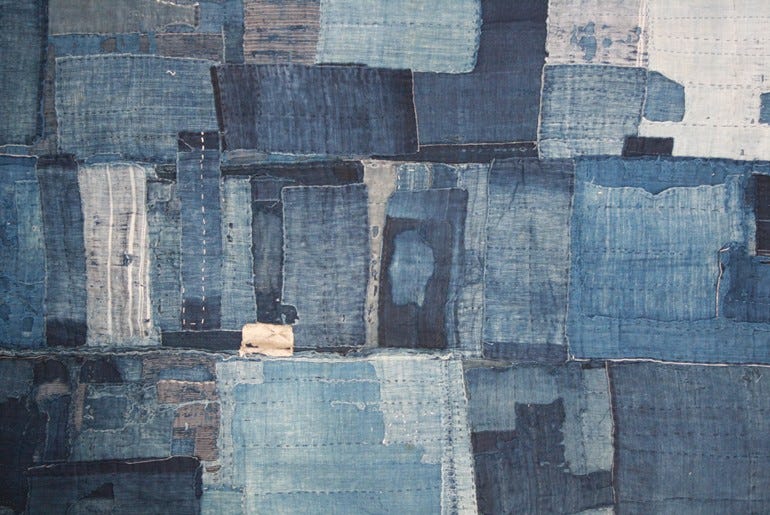
Image credit(boro)
Sashiko is often confused with Boro, but they refer to different things. Boro describes the fabric, usually made by layering and patching scraps of cloth to extend the life of worn garments. It is a visual archive of repair, with visible layers of use and history. Sashiko, by contrast, refers to the stitching technique itself—a method used to reinforce or mend fabric, often in geometric patterns. You’ll often see Sashiko stitches in Boro textiles, but Sashiko can also be used on its own. One refers to the cloth and its accumulated repair; the other to the act of stitching that holds things together.
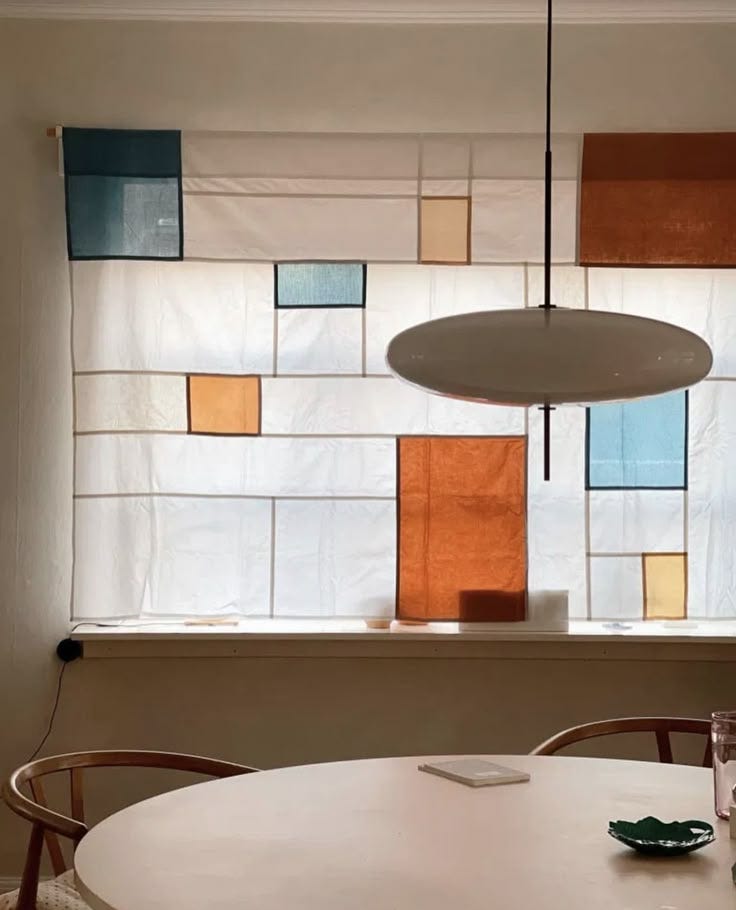
Image Credit: Korean Bojagi
Other cultures carry echoes of this ethos too, though few have managed to globalise their practices with the same precision as Japan. Korean Bojagi embraces visible seams and transparent patchwork to create cloths of symbolic and practical significance. In parts of West Africa, textile repair blends embroidery with storytelling. And yet, Sashiko has been uniquely scaled—not because it was simplified, but because its logic was already complete.
Japan’s ability to share its traditions with clarity—whether in the form of matcha, wabi-sabi, kintsugi, or Sashiko—lies not in branding, but in consistency. The aesthetic is never divorced from its ethic. The technique is never separate from its philosophy.
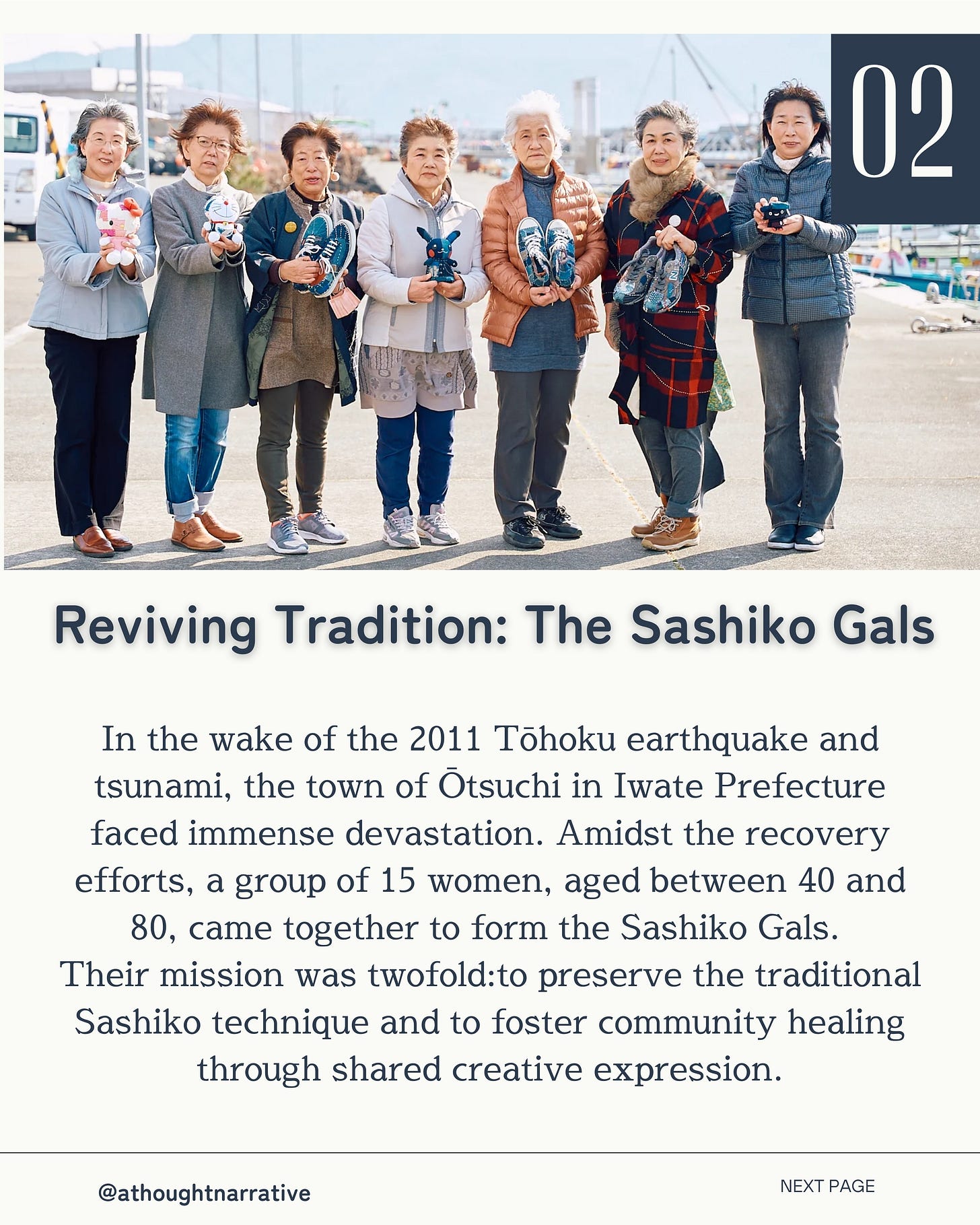
The Sashiko Gals of Ōtsuchi, Iwate—a collective of women who returned to stitching after the 2011 Tōhoku tsunami—began with intention and memory. Their practice was rooted in something already known to their hands, a method that offered grounding, calm, and continuity. What started as a deeply personal act gradually became a cultural beacon. Their hand-stitched pieces have since appeared in collaborations with Nike, VEJA, Dover Street Market, and C.P. Company. The garments may be new, but the process remains the same. Each stitch follows the original logic. Each motif holds the integrity it always did.
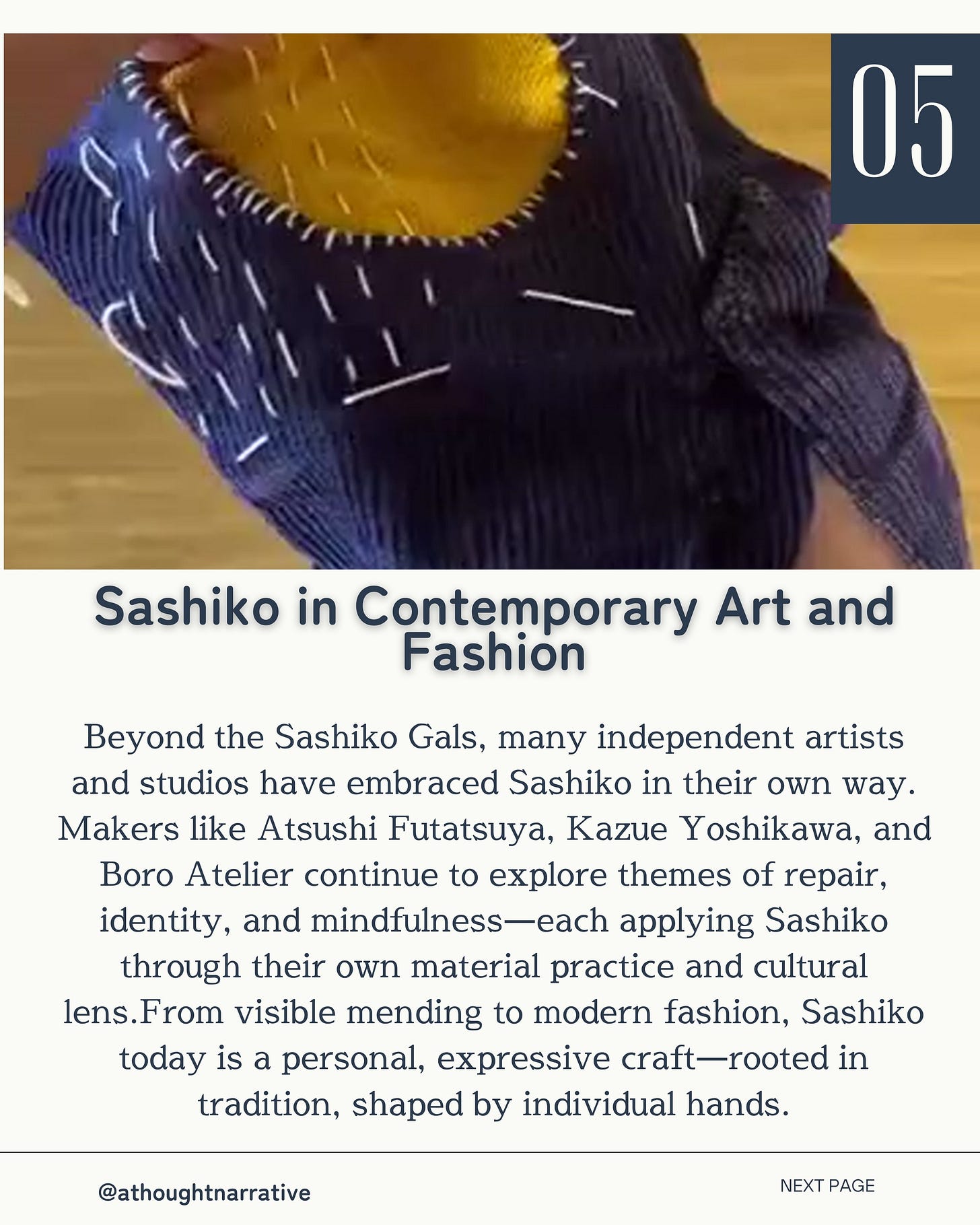
Across Japan and beyond, Sashiko has continued to evolve through the work of practitioners, educators, and studios who respect the form while exploring its relevance in contemporary life. Atsushi Futatsuya, through Upcycle Stitches, has built a widely respected body of documentation and instruction, bridging the gap between traditional technique and modern accessibility. Kazue Yoshikawa deepens the practice through her work in ritual, memory, and cultural research, drawing connections between material and meaning. In Amsterdam, Boro Atelier uses the Sashiko stitch as part of a larger material story, combining it with natural dyes, circular design, and visible mending as both philosophy and practice.
Beyond these institutions, Sashiko has been embraced by a growing community of global makers—artists, designers, menders, and stitchers who use it not only to repair garments, but to express identity, resist waste, and slow down. It has become part of a contemporary language of care—one that speaks through repetition, quiet structure, and attention to detail. For many, it is a deeply personal act: not a revival of a fading tradition, but a meaningful return to methods that still make sense.
This is what gives Sashiko its enduring presence. It works across contexts because it holds together—visually, philosophically, and structurally. It is precise without being rigid. Adaptable without losing clarity. Its strength lies in how it continues to function: as repair, as method, as form, and as quiet resistance to excess.
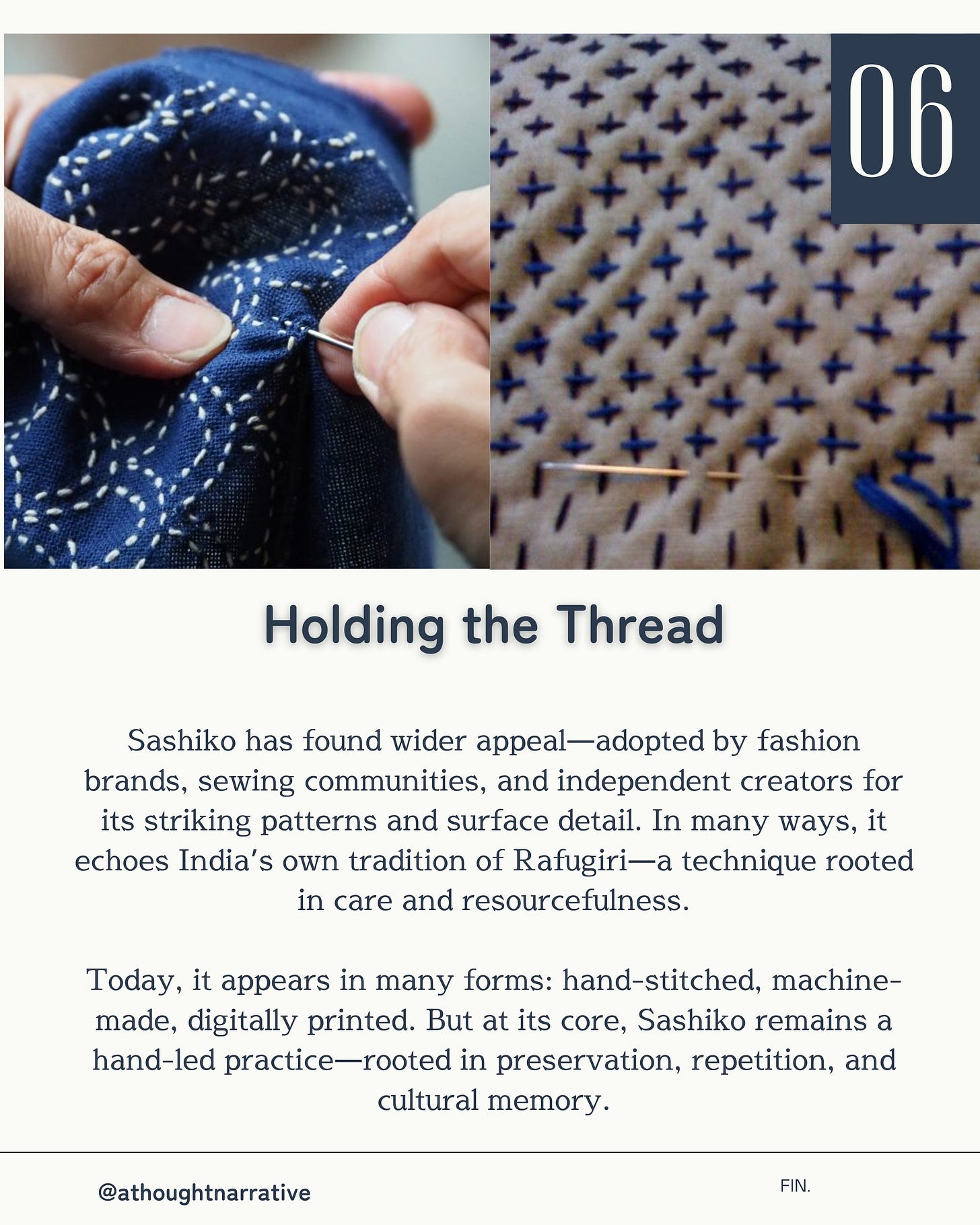
Sashiko is not a style. It is a framework. A way of reinforcing not just cloth, but meaning—stitched by hand, carried through generations, and still alive in the hands of those who choose to continue.
Referenced Practitioners & Studios for content and images :
Sashiko Gals – Ōtsuchi, Japan
Atsushi Futatsuya – Upcycle Stitches / Sashi.Co
Kazue Yoshikawa – Artist & researcher
Boro Atelier – Amsterdam-based fibre studio
Further Reading:
Kornica Dhar